Back
The Light at the End of the Wall
•
•
The first time I heard anyone talk about the ‘stages of spiritual growth’ was in a Thursday morning Bible study with Jeff and a few other guys. We were working through Practicing the Way by John Mark Comer.
I remember sitting there thinking, “Okay… hang on. What are we talking about here?” It felt like personality-test mumbo jumbo or something someone diagrams on a whiteboard at a leadership retreat. What it didn’t feel like was anything connected to my actual life with God.
Even with all my skepticism, something in it stuck just enough that months later, when I picked up The Critical Journey with that same crew of guys, I found myself wanting to dig deeper. Not because I suddenly understood it, but because something in my own story felt connected to whatever this framework was trying to describe.
Practicing the Way had opened doors in me I never would’ve opened on my own, and even though the whole “stages” idea still felt strange—almost like someone tried to squeeze the mystery of the soul into a chart—something in me kept tugging toward it.
For those who’ve never heard of the stages, welcome to the club. I was right there with you. They’re basically a way of describing the common patterns most people move through as they follow Jesus. Not everyone moves through all six. Not everyone moves through them in order. But for me, it tracked.
They go something like this:
Stage One: Recognition of God — waking up to God for the first time.
Stage Two: Life of discipleship — learning the basics and building a foundation.
Stage Three: Productive life — doing, serving, helping, achieving… the “let’s go change the world for Jesus” stage.
The Wall — when your soul stops cooperating with your old answers.
Stage Four: Journey inward — facing the deeper questions beneath your faith and letting God do work below the surface.
Stage Five: Journey outward — rebuilding a quieter, deeper faith with God’s help.
Stage Six: Life of love — a life marked by simple, steady love.
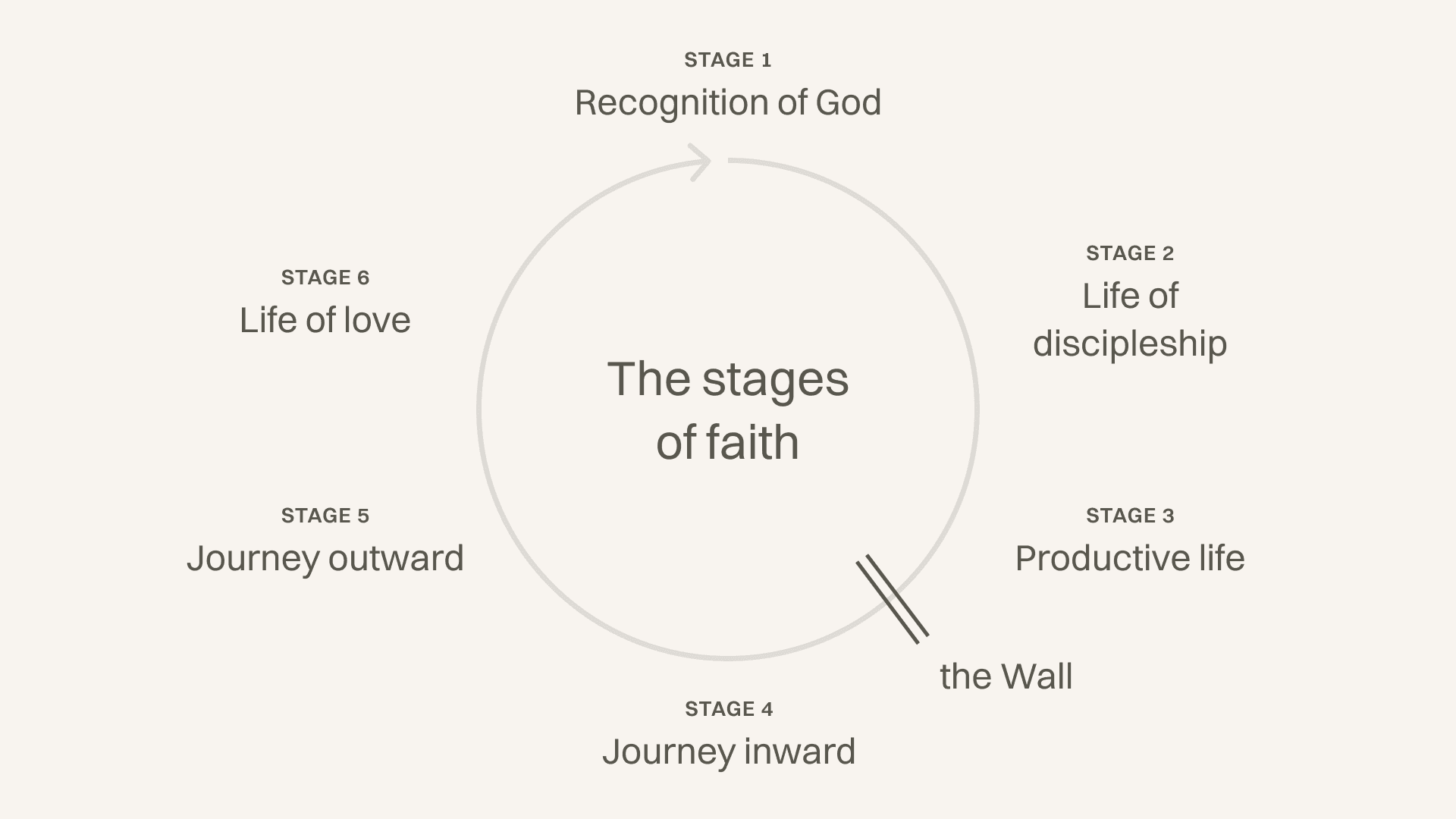
It's worth noting that some versions of this framework place the Wall after Stage Four. The truth is that the exact placement isn’t the point. What matters is recognizing the Wall for what it is—a place God uses to reshape us from the inside out, whatever stage we think we’re in.
When I started studying the stages more seriously, I realized that every stage was normal to experience. Just like you move from being a kid to a teenager to an adult, your soul moves through its own phases too. There’s nothing wrong with any stage. The only real problem is when you get stuck.
That’s exactly what happened to me.
I realized I had probably been parked in Stage Three for almost a decade. Yikes.
•••
Stage Three is great and, honestly, a little intoxicating. It’s the season where you’re productive, useful, needed, “all in.” You’re leading, serving, building, solving problems, giving your time, your resources, your energy. It feels like growth because there’s so much motion.
But here’s the part I didn’t see then: a lot of churches quietly treat Stage Three like the finish line. If you’re giving, serving, attending, and staying busy, you’re basically considered spiritually mature. Most churches get you to Stage Three as quickly as possible… and would love for you to stay there forever.
The only issue is that Stage Three can be one of the most spiritually dangerous places to get stuck, because it can feel like growth long after you’ve stopped actually growing.
Looking back, it makes sense why I stayed there so long. Beyond not even knowing these stages existed, I never slowed down long enough to ask honest questions about anything. Life felt predictable, and for a while that was enough. But eventually it all started to feel exhausting. Eventually "Stage Three Ronnie" ran out of gas, and I didn’t know what to do with the hollow feeling that crept in. I assumed something was wrong with me.
“Most churches get you to Stage Three as quickly as possible… and would love for you to stay there forever.”
What I couldn’t see then was that I was already walking toward the Wall. The cracks I felt in my faith were tied to deeper things I hadn’t faced yet. And the year my dad died was the moment I stepped into it, even though I didn’t have the language for any of this at the time.
•••
The Wall is the point in the journey where your old ways of following Jesus stop working. Everything that used to give you clarity or momentum starts to feel strangely thin. Not wrong, just… not enough anymore.
It’s the moment when the “outer life” you’ve built can’t carry the weight of your “inner life” anymore. Even good habits and good intentions start to hit limits you didn’t know were there. It’s also a time where you start questioning things that used to feel “fixed” and unquestionable. And if you’re anything like me, that can start to feel a lot like failure.
But the Wall isn’t failure.
It’s an invitation.
It’s the place where God does work beneath the surface, the stuff you can’t rush or manage or power through. The motivations behind your ministry, the fears beneath your confidence, the wounds beneath your strength—all of it starts rising to the top.
“The Wall isn’t failure. It’s an invitation.”
Most people don’t recognize it at first. I definitely didn’t. I tried every familiar strategy: doubling down, tightening up on my quiet time, taking on more, and trying to “get back on track.” But the Wall never responds to effort. It only responds to surrender.
For some, the Wall comes through grief or loss. For others, it shows up as burnout, disillusionment, or a quiet ache they can’t explain. When my dad died, I stepped into the Wall without realizing it. If that part of my story is helpful, I wrote more about it here: I Wasn’t Looking for God But He Found Me Anyway.
Wherever it comes from, the Wall is not God abandoning you. It’s God meeting you more deeply than before, just not in the ways you’re used to.
Looking back, one of the strangest gifts of the stages is that once you see them, you can’t unsee them.
That’s the upside… and the risk.
Because at first, the temptation was very real to start mentally assigning stages to everyone in my life like I was carrying around spiritual trading cards. I didn’t mean to, but suddenly I was trying to “diagnose” people. I’d hear someone talk about their walk with God and think, “Ah yes, "Stage Two" energy.” Nothing says “still learning” like trying to categorize the people you love.
Over time, though, that instinct loosened. Curiosity replaced judgment. The stages slowly turned into grace.
•••
I started seeing that people thriving in Stage One aren’t naïve at all. They’re alive in a way that’s easy to forget once you’ve been walking with Jesus for a while. My mom actually comes to mind here. She’s spent so much of her life in this place of simple, child-like awe with a real sense of wonder toward God that, if I’m honest, I don’t always have. I used to interpret that as a lack of depth. Now I know it’s the kind of depth I wish I had more of. Thank you, mom for modeling that deep and profound sense of wonder. It reminds me, even today, to stop and take in the goodness of God.
People faithfully working hard in Stage Three aren’t performers. They’re serving because they love Jesus, even if they can’t yet see how much pressure they’re carrying.
People wrestling in Stage Four aren’t backsliding. They’re growing in ways that don’t look impressive, but are probably more real than anything they’ve experienced before.
The stages gave me language for grace, for myself and for others.
They also changed the way I viewed God.
Up until the Wall, I lived with the quiet assumption that God mostly needed things from me. Produce. Contribute. Serve. That was how I knew I mattered. If I wasn’t doing something for God, I wasn’t sure what He wanted from me.
“The stages gave me language for grace, for myself and for others.”
At the Wall, that illusion started breaking open. God began dealing with buried things like the fears, the wounds, the identities I built around being competent and helpful. And painfully but kindly, I started to believe something I should’ve known all along:
God wanted me.
Not my output.
Not my urgency.
Not my spiritual résumé.
Just me.
And that shifted something deep in me that I’m still trying to understand.
•••
I don’t think I’m fully through the Wall yet, but I’m not where I was. I see the faint light at the end of the tunnel, I mean Wall. I’m learning that transformation starts below the surface long before you feel it.
I’m learning that God is far more patient with me than I ever was with myself.
If you’re somewhere on this journey, especially if you feel lost, confused, or behind… I hope this takes some pressure off your shoulders.
You’re not behind.
You’re not failing.
You’re not alone.
You’re just somewhere on the path.
And God knows exactly where He has you.
Become a member of The Vineyard
Through monthly support, members make space for reflection, honesty, and the slow work of formation that Voice & Vine was created to nurture. Learn more

Ronnie lives in McKinney, TX with his wife Dannie and their two daughters. He runs a creative agency called GoodFolks, helping brands and organizations tell stories that matter. Alongside his work there, he co-created Voice & Vine as a way to explore faith, creativity, and healing through honest conversation and reflection. His journey has been shaped by a love for building meaningful things—both in business and in life—and by a growing desire to slow down and return to what’s true. Whether leading creative teams or sharing life around the table, Ronnie continues to learn what it means to live from a place of faith, humility, and hope.
Other writings